

Development course of biomedical Ti Alloys
Metallic materials are the earliest traditional materials in the history of human biomedical development for wound repair and orthopedic treatment. Since the 1930s, CoCr alloy, and stainless steel have successively been used in the field of medicine and become the current traditional metallic materials for medical treatment; In the 1940s, the more superior performing biomedical titanium was studied and demonstrated its clinical feasibility. Biomedical titanium alloys have experienced 3 processes, from pure titanium, Ti-6Al-4V titanium, and improved titanium to low modulus β :
◆1950-1980: pure titanium was first used in the biomedical field and good biocompatibility was confirmed. Ti-6Al-4V is widely used in the surgical repair or replacement materials.
◆1980-1990: it was confirmed that V and Al are elements with toxic and side effects on organisms; The second generation of improved new medical titanium alloy with Nb and Fe replacing V was developed.
◆1990 - present: β Titanium alloy Ti13Nb13Zr with better biocompatibility and lower elastic modulus was developed in the early 1990s, Biomedicine with excellent properties has since been opened β Development and use of titanium alloys.
Domestic research status and problems
China has started the research and application of medical titanium alloy materials in the 1970s, through the previous imitation research on Ti-6Al-4V, Ti-6Al-7Nb, and ti-5al-2.5fe medical titanium alloys, As early as 1999, Northwest Nonferrous Metals Research Institute first developed the first α A new medical titanium alloy TAMZ (Ti-2.5Al-2.5Mo-2.5Zr) has the same comprehensive properties as Ti-6Al-7Nb.
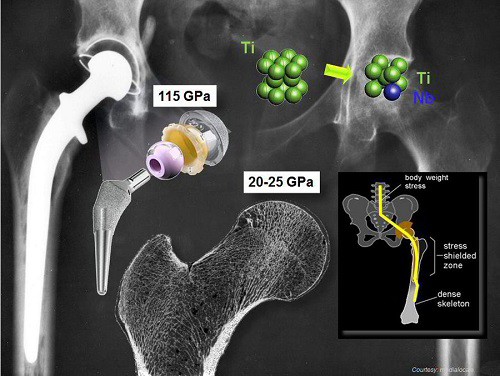
In 2005, the Northwest Institute of nonferrous metals developed 2 new high strength and low modulus near β Tizrmonb (TLE) and Ti Zr Sn Mo Nb (TLM) are medical titanium alloys. The Institute of metals of the Chinese Academy of Sciences has also developed a new low modulus near β Titanium alloy ti-24nb-4zr-7.6sn (Ti 2448). In addition, the Beijing Institute of nonferrous metals, Harbin Institute of Technology, Northeast University, Tianjin University, and other units are also carrying out new β The application and related basic research of type a titanium alloy.
Based on China's national conditions, China is a large country with about 1.3 billion people and 60million disabled people, and China is stepping into an aging society. Therefore, it is necessary to provide a large number of high-quality biomedical materials and devices for clinical diagnosis and treatment. However, the research on medical implants in China started relatively late. At present, nearly half of the artificial joints need to be imported, while more than 90% of dental implants and some high-end implants use imported products, which are very expensive and difficult for ordinary working-class people to bear. Therefore, the development of new titanium alloys with non-toxic, low elastic modulus, and low price is a subject worthy of study.