


The entrainment of liquid droplets in gas streams is a common challenge in chemical production; it can compromise product quality or, in more severe cases, damage downstream equipment. With their high separation efficiency, low pressure drop, and compact design, wire mesh mist eliminators have become the primary solution for gas-liquid separation. This article outlines a comprehensive approach to addressing this issue from a process engineering perspective.
I. Problem Diagnosis: Identifying What Needs to be Removed
The first step in designing a solution is to define the target of the separation: the droplet size distribution (standard wire mesh can typically capture droplets ≥5 μm, while high-efficiency versions can reach 3 μm), droplet concentration, the presence of solid particles, and any tendency for the liquid to crystallize or polymerize. If the gas contains dust, pre-filtration or a clog-resistant mesh design is required; if the droplets have high viscosity, provisions for cleaning must be considered. Implementing equipment without proper assessment often leads to clogging or failure to meet efficiency targets.
II. Process Calculations: Gas Velocity and Diameter are Key
Wire mesh mist eliminators rely on inertial impaction and direct interception to achieve separation. The design gas velocity is typically set at 50%–80% of the flooding velocity-a value calculated using the Souders-Brown equation, which accounts for the density difference between the gas and liquid phases as well as the specific characteristics of the wire mesh. If the gas velocity is too low, efficiency drops; if it is too high, flooding and back-mixing occur. These parameters determine the diameter of the mist eliminator and the thickness of the wire mesh (typically 100–150 mm, though this can be increased for high-efficiency applications).
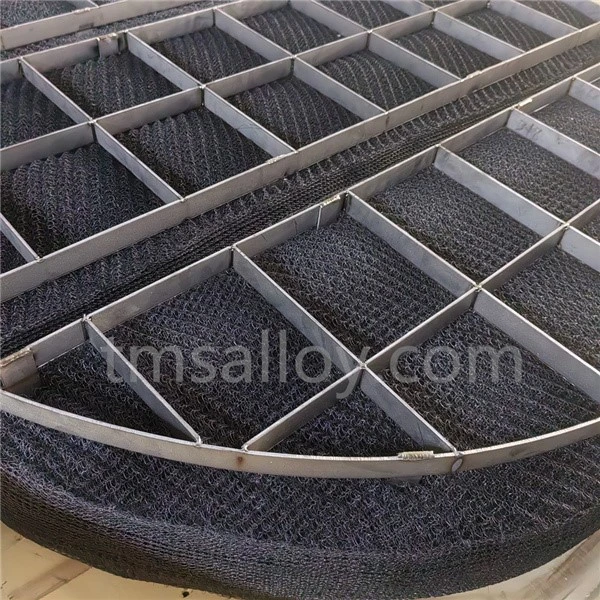
III. Selecting the Structural Configuration
Tower Internals: Installed directly at the top of or within a tower; this compact design is ideal for new tower construction.
Standalone Vessels: Gas-liquid separators installed in pipelines or at the outlets of other equipment; these can be equipped with integrated liquid drainage systems.
Multi-stage Combinations: A combination of wire mesh and swirl vanes or baffle plates, designed to handle high liquid loads or a wide range of droplet sizes.
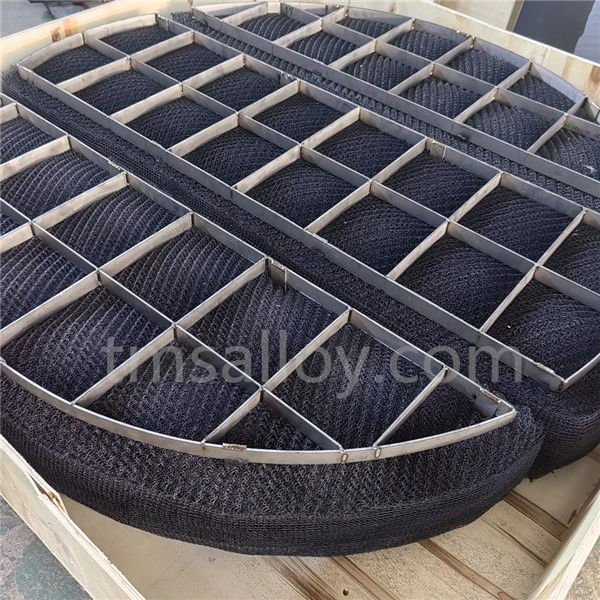
For large-diameter towers, a drawer-style or sectional (modular) wire mesh design is recommended to facilitate installation and maintenance. IV. Material Selection and Operating Conditions
For general operating conditions, SS304 or SS316L is typically selected. In environments containing chlorides, Grade 2 (Gr2) titanium or duplex stainless steel should be used. For highly acidic environments, nickel-based alloys or non-metallic materials are required. In cases involving high-temperature flue gas, the temperature limits of the chosen materials must be taken into account. The proposal should specify the material grade and include a corrosion-resistance assessment.
V. Pressure Drop and Energy Consumption Control
The pressure drop across a wire mesh demister is generally between 50 and 250 Pa (in a clean state); a design margin should be incorporated. Excessive pressure drop increases fan energy consumption; this can be mitigated by increasing the flow area or optimizing the wire mesh specifications. The proposal should state both the clean-state pressure drop and the estimated operating pressure drop.
VI. Essential Auxiliary Design Features
Necessary features include spray nozzles (to prevent crystallization or fouling), drainage pipes (with sufficient diameter to avoid liquid sealing/trapping), structural strength verification for support grids, and the inclusion of access manholes for maintenance. These details are critical to the long-term operational reliability of the equipment.
VII. Deliverables
A comprehensive proposal should include: a table of operating parameters, selection calculations, a structural schematic, material specifications, estimates for pressure drop and efficiency, as well as installation requirements and maintenance recommendations.
In summary, the core principle for developing a gas-filtration wire mesh demister solution is: "define parameters based on operating conditions, determine the structure based on those parameters, and select materials based on the structure." A systematic design approach is the only way to ensure high efficiency, low flow resistance, and long-term, reliable operation.
Contact information:
Tel: +86-0917- 3664600
WhatsApp: +8618791798690


