


Although a wire mesh mist eliminator may look simple, selecting one involves multiple factors, including material, specifications, and manufacturing processes. A clear purchasing guide can help buyers avoid common pitfalls and ensure they procure a product that is truly suited to their specific operating conditions.
I. Define Operating Parameters
Before purchasing, you must have the following fundamental data: gas flow rate (m³/h), operating pressure, operating temperature, medium composition (especially chloride ion content), droplet size and concentration, and allowable pressure drop. These parameters directly dictate the choice of wire mesh specifications and materials. For instance, high gas velocities require a larger mist eliminator diameter to manage pressure drop, while media containing chlorides necessitate avoiding 304 stainless steel.
II. Determine the Structural Configuration
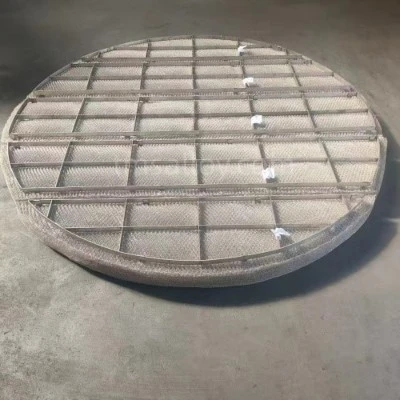
Common configurations include disc-type (circular or square), drawer-type, top-mounted, and bottom-mounted designs. Disc-type units are simple and cost-effective, making them suitable for most towers. Drawer-type units facilitate easy inspection and replacement, ideal for large towers or applications requiring frequent maintenance. Top-mounted or bottom-mounted configurations are selected based on the location of the access openings on the tower. When purchasing, ensure that the dimensions align with the tower's flanges and support rings.
III. Select Wire Mesh Specifications
Key parameters include wire diameter (typically 0.1–0.3 mm), mesh type (standard, high-efficiency, or anti-clogging), specific surface area, and void fraction. Standard types are used for general separation; high-efficiency types feature finer wires and a larger specific surface area, offering superior separation efficiency at the cost of a higher pressure drop. Anti-clogging types utilize a corrugated design or larger wire diameters, making them suitable for environments containing dust or substances prone to crystallization. Gas velocity is generally maintained at 0.5–0.8 times the design gas velocity.
IV. Confirm Materials
Beyond SS304, common materials include SS316L, 321, duplex stainless steel, Grade 2 titanium, nickel-based alloys, and non-metallic materials such as PP or PVC. The choice of material is primarily determined by the corrosivity of the medium, while also accounting for temperature and cost. Buyers should request a Material Test Certificate (MTC) from the supplier and, if necessary, conduct a spectral analysis to verify the material composition.
Contact Us
No.11th Road of Gaoxin, Baoji, Shaanxi, P.R.China
Tel: +86-0917- 3664600
Fax: +86-0917- 3664600
WhatsApp: +8618791798690
Mail: sales@tmsalloy.com


