


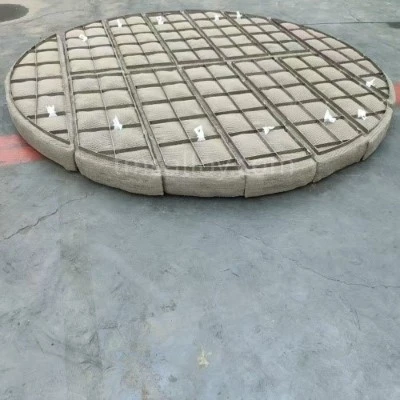
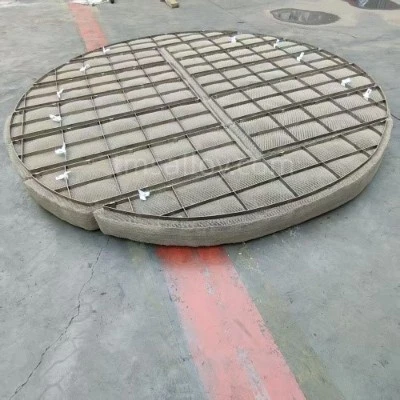
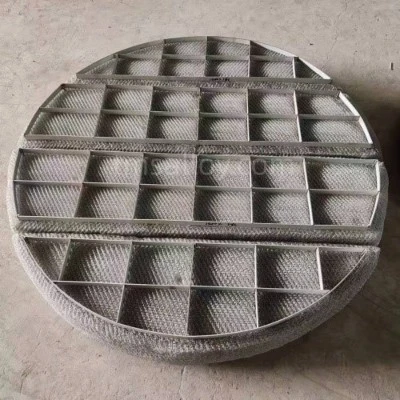
In industrial sectors such as chemical processing, petroleum, and pharmaceuticals, wire mesh demisters serve as critical equipment for gas-liquid separation. SS304 stainless steel and Gr2 titanium are two common material choices for these demisters, differing significantly in terms of material properties, suitable operating conditions, and cost.
I. Fundamental Material Differences
SS304 is an austenitic stainless steel, primarily composed of 18% chromium and 8% nickel; it offers a good balance of corrosion resistance and processability. Gr2 titanium (TA2) is a commercially pure titanium-containing at least 99.2% titanium, classified as an alpha-phase (α-type) alloy, renowned for its exceptional corrosion resistance, low density, and high strength.
II. Comparison of Corrosion Resistance
This is the most critical distinction between the two. While SS304 performs well in oxidizing media (such as nitric acid, the atmosphere, or fresh water), it is susceptible to pitting and stress corrosion cracking in chloride-containing environments (such as seawater or hydrochloric acid). In contrast, Gr2 titanium is virtually immune to chloride ions, demonstrating superior corrosion resistance in seawater, chloride solutions, oxidizing acids, and even wet chlorine gas. Titanium rapidly forms a dense oxide film when exposed to air-a film capable of self-repair if damaged.
Consequently, for applications involving chlorides-such as offshore platforms, chlor-alkali chemical production, or seawater desalination-Gr2 titanium wire mesh demisters are essentially the only reliable choice. SS304, meanwhile, is better suited for general atmospheric conditions, fresh water, and environments with only mild corrosivity.
III. Mechanical Properties and Temperature Resistance
SS304 has a density of about 7.93 g/cm³, a tensile strength of about 520 MPa, and a broad operating temperature range (-196°C to 800°C). Gr2 titanium has a much lower density of 4.51 g/cm³ and a high strength-to-weight ratio; it possesses a tensile strength of approximately 440 MPa, though its elastic modulus is relatively low. Titanium retains good corrosion resistance at high temperatures; however, its oxidation accelerates above 300°C. Consequently, it is generally recommended that its long-term operating temperature not exceed 300°C. SS304 exhibits greater stability in high-temperature oxidizing environments, though one must be mindful of the 400–800°C sensitization range, which can trigger intergranular corrosion.
IV. Cost and Economic Considerations
SS304 is relatively affordable, widely available, and benefits from mature processing and welding techniques. In contrast, the raw material cost for Grade 2 (Gr2) titanium is typically 3–5 times that of SS304. Furthermore, titanium is more difficult to process and requires inert gas shielding during welding, leading to significantly higher overall costs. Therefore, unless the specific operating conditions mandate the use of titanium, SS304 is the more cost-effective choice.
V. Selection Recommendations
Choose SS304 for: General chemical processing, water treatment, food and pharmaceutical applications, or atmospheric environments where chloride ions are absent or present only in extremely low concentrations.
Choose Gr2 Titanium for: Seawater, chlor-alkali processes, wet chlorine gas, chloride solutions, marine engineering, or applications sensitive to metal-ion contamination.
In summary, the fundamental distinction between the two lies in their respective roles: "general-purpose corrosion resistance" versus "extreme chloride resistance." When selecting a material, one should comprehensively evaluate the medium's composition, chloride ion concentration, temperature, and budget-ensuring that the choice avoids both "over-specification" (which leads to unnecessary expense) and "under-specification" (which results in premature equipment failure).
Contact Us
No.11th Road of Gaoxin, Baoji, Shaanxi, P.R.China
Tel: +86-0917- 3664600
Fax: +86-0917- 3664600
WhatsApp: +8618791798690
Mail: sales@tmsalloy.com


