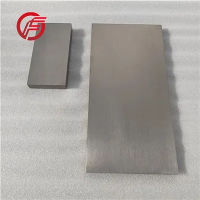

In the world of high - speed rotating equipment, the choice of materials is crucial. The equipment's performance, durability, and safety all depend on the materials used in its construction. As a TZM plate supplier, I've been asked numerous times whether a TZM plate can be used in high - speed rotating equipment. In this blog, I'll explore this question in detail, considering the properties of TZM plates, the requirements of high - speed rotating equipment, and real - world applications.
Properties of TZM Plates
TZM (Titanium - Zirconium - Molybdenum) is a molybdenum - based alloy that offers a unique combination of properties. Molybdenum itself is a refractory metal with a high melting point of 2623°C, excellent thermal conductivity, and good electrical conductivity. When alloyed with small amounts of titanium and zirconium, along with a trace of carbon, the resulting TZM alloy has enhanced mechanical properties.
One of the key advantages of TZM plates is their high strength at elevated temperatures. This is due to the formation of fine - dispersed carbide particles during the alloying process, which impede the movement of dislocations in the crystal lattice, thereby strengthening the material. For example, TZM can maintain its strength at temperatures up to 1650°C, which is significantly higher than many other metals and alloys.
TZM plates also have good creep resistance. Creep is the tendency of a material to deform slowly under a constant load at high temperatures. In high - speed rotating equipment, where components are often subjected to high centrifugal forces and elevated temperatures, creep resistance is essential to prevent premature failure. The fine - grained structure and the presence of carbide particles in TZM contribute to its excellent creep resistance.
Another important property is its low coefficient of thermal expansion. This means that TZM plates will expand and contract less with changes in temperature compared to many other materials. In high - speed rotating equipment, thermal expansion can cause misalignment, vibration, and stress concentration, which can lead to mechanical failure. The low thermal expansion of TZM helps to maintain dimensional stability, reducing the risk of these problems.
Requirements of High - Speed Rotating Equipment
High - speed rotating equipment, such as turbines, generators, and centrifuges, has several strict requirements for the materials used in its construction. Firstly, the material must have high strength to withstand the high centrifugal forces generated during rotation. The centrifugal force is proportional to the mass of the rotating component, the square of its angular velocity, and the distance from the axis of rotation. As the rotational speed increases, the centrifugal force can become extremely large, requiring a material with high tensile and yield strength.
Secondly, the material should have good fatigue resistance. High - speed rotating equipment often operates under cyclic loading conditions, which can cause fatigue cracks to initiate and propagate over time. Fatigue failure can occur suddenly and without warning, leading to catastrophic equipment failure. A material with good fatigue resistance can withstand a large number of loading cycles without failure.
In addition, high - speed rotating equipment requires materials with good dimensional stability. Any change in the dimensions of the rotating components can lead to imbalance, vibration, and increased wear. Dimensional stability is particularly important at high temperatures, as thermal expansion can cause significant changes in the size and shape of the components.
Can TZM Plates Meet the Requirements?
Based on the properties of TZM plates and the requirements of high - speed rotating equipment, it is clear that TZM plates have the potential to be used in such applications.
In terms of strength, the high - temperature strength of TZM plates makes them suitable for withstanding the high centrifugal forces in high - speed rotating equipment. For example, in a high - speed turbine, the blades are subjected to extremely high centrifugal forces and operate at high temperatures. TZM plates can provide the necessary strength to ensure the safe and reliable operation of the turbine blades.
Regarding fatigue resistance, the fine - grained structure and the presence of carbide particles in TZM plates contribute to their good fatigue performance. The carbide particles can act as barriers to crack propagation, increasing the number of loading cycles that the material can withstand before failure. This makes TZM plates a good choice for components in high - speed rotating equipment that are subjected to cyclic loading.
The low coefficient of thermal expansion of TZM plates also helps to meet the requirement of dimensional stability. In high - speed rotating equipment, maintaining the correct dimensions of the components is crucial for smooth operation. The low thermal expansion of TZM reduces the risk of thermal - induced misalignment and vibration, ensuring the long - term reliability of the equipment.
Real - World Applications
There are already some real - world applications of TZM plates in high - speed rotating equipment. In the aerospace industry, TZM is used in the construction of rocket engine components, such as turbine blades and impellers. These components operate at high temperatures and high rotational speeds, and the properties of TZM plates make them well - suited for these applications.
In the semiconductor industry, high - speed centrifuges are used for wafer processing. TZM plates can be used in the construction of the centrifuge rotors, providing the necessary strength, fatigue resistance, and dimensional stability.
Related Products
If you are interested in other molybdenum - based products for your high - speed rotating equipment, we also offer Molybdenum Screw, TZM Molybdenum Alloy Bar, and Molybdenum Wire. These products also have excellent properties and can be used in combination with TZM plates to meet your specific needs.
Conclusion
In conclusion, TZM plates have the potential to be used in high - speed rotating equipment. Their high strength at elevated temperatures, good creep and fatigue resistance, and low coefficient of thermal expansion make them suitable for meeting the strict requirements of such equipment. Real - world applications in the aerospace and semiconductor industries have already demonstrated the effectiveness of TZM plates in high - speed rotating environments.


If you are considering using TZM plates in your high - speed rotating equipment, I encourage you to contact us for more information. We can provide you with detailed technical specifications, samples, and pricing. Our team of experts is also available to assist you in selecting the right materials and products for your specific application. Let's start a conversation about how our TZM plates can enhance the performance and reliability of your high - speed rotating equipment.
References
- "Molybdenum and Its Alloys" by John F. Elliott.
- "High - Temperature Materials and Their Applications" edited by Robert A. Rapp.
- "Materials Science and Engineering: An Introduction" by William D. Callister, Jr. and David G. Rethwisch.