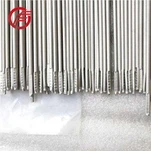


Ti-6Al-4V is a martensitic a+/β two-phase titanium alloy with good comprehensive properties. Its service temperature can reach 450. It is widely used in important structural parts of the aviation industry, such as wing blades and aero-engine disks.
As Ti-6Al-4V titanium bar is a two-phase titanium alloy, if the composition of the micro-area is not uniform, it will inevitably cause abnormal macrostructure and micro-structure, which will result in a significant difference in hardness between the abnormal area and the normal area. As a result, the material shows uneven properties as a whole, and finally generates the source of fatigue cracks, which brings great potential hazards to the safety of parts and reduces the service life of the alloy.
In order to accurately determine the type of defects, the microstructure of a TC4 titanium bar processed product is observed by a metallographic microscope to determine the abnormal areas of its metallographic structure. the segregation defects of chemical composition in black stripe areas rich in molybdenum and poor in aluminum were analyzed by SEM. The composition segregation of the black stripe zone is non-brittle by the microhardness test.

The test results show that the segregation and its type of TC4 titanium alloy can be effectively determined by the above methods. It is also determined that this type of defect will not affect the use and can be delivered after removal. Such defects can be reduced or eliminated by controlling raw material selection, mixing and electrode preparation, voltage, and current during smelting. segregation of titanium alloys can be divided into hard segregation (hardness higher than normal area, also called brittle segregation) and soft segregation (hardness lower than normal area, also called non-brittle segregation) according to the difference between the high and low hardness of segregated parts and normal area.
If only non-brittle segregation exists in the product and the properties meet the requirements of product standards, the product can still be delivered after the segregation is generally removed; brittle segregation is not allowed to be removed for post-delivery and should be scrapped as a whole. the author discussed the analysis and judgment method of non-brittle segregation encountered in the segregation of Ti-6Al-4V Titanium Bar, in order to provide a reference for product inspection and improve product quality.

A. Observe the black stripe defect of TC4 titanium bar by metallographic microscope. The defect area is not different from the normal area and the type of defect can not be judged. the chemical composition of the defective area of the titanium bar was further analyzed by scanning electron microscope (SEM). The defective area is huge segregation of chemical elements rich and poor in aluminum. finally, the segregation type of TC4 titanium bar is determined as non-brittle segregation rich and poor aluminum by microhardness test. component segregation and its type of TC4 titanium alloy can be effectively determined by combining microscopic observation, micro area component analysis, and microhardness test.
B. The segregation in the Ti-6Al-4V titanium bar is non-brittle segregation rich in and poor in aluminum, which does not affect its use and can be delivered after removal. Such defects can be reduced or eliminated by controlling material selection, mixing and electrode preparation parameters, voltage, and current during smelting.