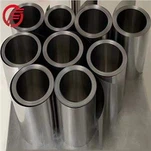


For titanium tubes, heat treatment techniques like annealing, solid solution, and aging treatment are frequently utilized. Annealing is to eliminate internal stress, and improve plasticity and structural stability, so as to obtain better comprehensive properties. Usually, the annealing temperature of α alloy and (α+β) alloy is selected at 120-200°C below the (α+β)─→β phase transformation point; solid solution and aging treatment are rapidly cooled from the high-temperature zone to obtain martensite α′ phase and metastable β phase, and then keep warm in the medium temperature zone to decompose these metastable phases to obtain finely dispersed second phase particles such as α phase or compounds, so as to achieve the purpose of strengthening the alloy.

The heat treatment process of titanium tube can be summarized as:
(1) Solution treatment and aging: The purpose is to improve its strength. α titanium tubes and stable β titanium tubes cannot be subjected to intensive heat treatment, and only annealing is performed during production. α+β titanium tubes and metastable β titanium tubes containing a small amount of α phase can be further strengthened by solution treatment and aging.
(2) Complete annealing: This process is used to achieve good toughness, enhance processing efficiency, make reprocessing easier, and increase size and structure stability.
(3) Tension relief annealing: This technique is used to decrease or eliminate any remaining stress that was created during processing. Prevents chemical attacks and reduces deformation in some corrosive environments.
In addition, in order to meet the special requirements of the workpiece, industrial titanium tubes also adopt metal heat treatment processes such as double annealing, isothermal annealing, β heat treatment, and deformation heat treatment.
Titanium tubes are mainly used to make aircraft engine compressor components, followed by structural parts of rockets, missiles, and high-speed aircraft. Titanium and its alloys have been utilized in a variety of general industries since the middle of the 1960s, including electrodes for the electrolysis industry, condensers for power plants, heaters for petroleum refining and seawater desalination, and equipment to reduce environmental pollution. There are now corrosion-resistant structural materials made of titanium and its alloys. It is also employed in the creation of shape-memory alloys and hydrogen storage materials.

Titanium tube has excellent mechanical qualities, good toughness, and resistance to corrosion. It is also lightweight and strong. In addition, the process performance of titanium tubes is poor, and it is difficult to cut and process. During thermal processing, it is very easy to absorb impurities such as hydrogen, oxygen, nitrogen, and carbon. Also have poor wear resistance, and a complex production process. The industrial production of titanium began in 1948. The titanium industry is growing at an average annual growth rate of about 8% due to the need to develop the aviation sector. At present, the annual output of titanium tube processing materials in the world has reached more than 40,000 tons, and there are nearly 30 kinds of titanium tube grades. The most widely used titanium tubes are Ti-6Al-4V (Gr5), Ti-5Al-2.5Sn (BT5-1), and industrial pure titanium (Gr1, Gr2, and Gr3).