
As a titanium supplier, I often encounter various inquiries about titanium, ranging from its properties and applications to more fundamental questions like its atomic number. In this blog, I'll delve into the atomic number of titanium and explore its significance in the world of chemistry and materials science.
Titanium, with the chemical symbol Ti, holds a special place in the periodic table. Its atomic number is 22. But what exactly does the atomic number represent? Well, the atomic number of an element is the number of protons found in the nucleus of an atom of that element. It serves as a unique identifier for each element, distinguishing it from all others. For titanium, having an atomic number of 22 means that every titanium atom contains 22 protons in its nucleus.
The atomic number is not just a random number; it has far - reaching implications in the behavior and properties of an element. The number of protons in an atom determines its positive charge, which in turn influences how the atom interacts with other atoms. In the case of titanium, its 22 protons attract a corresponding number of electrons in a neutral atom (since atoms are electrically neutral, with the number of protons equaling the number of electrons). This electron configuration affects titanium's chemical reactivity, bonding ability, and physical properties.
Chemically, titanium is relatively unreactive, especially when it forms a stable oxide layer on its surface. This passivation layer protects the metal from further corrosion, making it suitable for a wide range of applications in harsh environments. The electron configuration due to the atomic number also gives titanium a high strength - to - weight ratio. Its metallic bonds, formed by the sharing of electrons among the atoms, contribute to its strength, while its relatively low density means it is lightweight compared to many other metals.
In the field of materials science, titanium's atomic number is the starting point for understanding its alloys. By adding other elements to titanium, we can change the electron environment and alter the properties of the resulting alloy. For example, some titanium alloys are designed to have enhanced corrosion resistance, while others are optimized for high - temperature applications. Knowledge of the atomic number helps in predicting how different elements will interact with titanium at the atomic level and how they will influence the overall performance of the alloy.
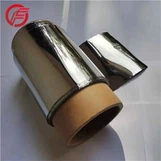
When it comes to our role as a titanium supplier, understanding the atomic number is just the tip of the iceberg. We need to know how the unique properties arising from this atomic number translate into real - world applications. One of the popular products we offer is the Gr2 Titanové Desky. Grade 2 titanium is an unalloyed titanium with excellent corrosion resistance, good formability, and moderate strength. These properties are directly related to the atomic structure of titanium, which is defined by its atomic number.
The Gr2 Titanové Desky are used in a variety of industries. In the chemical industry, their corrosion resistance makes them ideal for equipment such as heat exchangers, reactors, and piping systems. They can withstand the harsh chemicals and high - temperature environments often found in chemical processing plants. In the marine industry, these titanium sheets are used for shipbuilding, offshore platforms, and desalination plants. The ability of titanium to resist corrosion in saltwater is a significant advantage, as it extends the lifespan of the equipment and reduces maintenance costs.
In the medical field, titanium's biocompatibility is a crucial property. The human body does not reject titanium implants, which is related to its stable atomic structure and the way it interacts with biological tissues. The Gr2 Titanové Desky can be used to manufacture medical implants such as dental implants, joint replacements, and bone plates. The atomic number of titanium plays an underlying role in these applications, as it determines the metal's chemical and physical properties that are essential for its use in the human body.
Another important aspect of our business as a titanium supplier is quality control. We use advanced testing techniques to ensure that our products meet the highest standards. These techniques are based on our understanding of the atomic structure of titanium. For example, X - ray diffraction can be used to analyze the crystal structure of titanium, which is related to its atomic arrangement. By ensuring that the crystal structure is consistent, we can guarantee the quality and performance of our Gr2 Titanové Desky.
We also work closely with our customers to provide them with the best solutions for their specific needs. Whether they need titanium sheets for a small - scale project or a large - scale industrial application, our team of experts can offer advice based on our in - depth knowledge of titanium. We understand that different industries have different requirements, and we strive to meet those needs by providing high - quality titanium products.
If you are in the market for titanium products, especially the Gr2 Titanové Desky, we encourage you to reach out to us. Our team is ready to discuss your project requirements, answer any questions you may have, and provide you with a competitive quote. Whether you are a small business looking for a reliable titanium supplier or a large corporation in need of bulk orders, we have the expertise and resources to meet your needs.
In conclusion, the atomic number of titanium, which is 22, is the foundation of its unique properties and applications. As a titanium supplier, we rely on this fundamental knowledge to provide high - quality products and excellent service to our customers. Whether you are involved in the chemical, marine, medical, or any other industry that uses titanium, we are here to support you. Contact us today to start a conversation about your titanium needs and let us help you find the best solutions for your projects.

References:
- "The Periodic Table: A Visual Guide to the Elements" by DK Publishing
- "Titanium: A Technical Guide" by ASM International