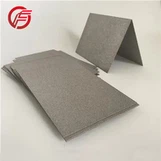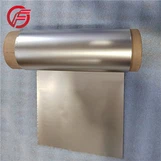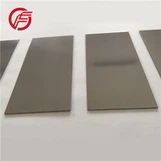

As a leading supplier of moly foil, I often receive inquiries regarding the dimensions available for this versatile product. Molybdenum foil is a key material in various industries due to its exceptional properties such as high melting point, low thermal expansion, and excellent electrical conductivity. Understanding the different dimensions of moly foil is crucial for buyers to ensure that they get the right product for their specific applications.
Standard Dimensions of Moly Foil
Moly foil is available in a wide range of thicknesses, widths, and lengths. In terms of thickness, it can vary from as thin as 0.001 inches (0.0254 mm) to relatively thick foils of around 0.01 inches (0.254 mm). The thinner foils, typically in the range of 0.001 - 0.005 inches (0.0254 - 0.127 mm), are commonly used in applications where flexibility and high surface area are required, such as in electronics for insulation or in the production of thin-film circuits. These ultra-thin foils can be handled with care and are often supplied in rolls to facilitate easy storage and usage.
Medium-thickness foils, in the range of 0.005 - 0.008 inches (0.127 - 0.2032 mm), offer a good balance between flexibility and strength. They are suitable for applications like heat shields in aerospace and automotive industries, where they need to withstand moderate mechanical stress while still being able to conform to specific shapes.
Thicker foils, from 0.008 - 0.01 inches (0.2032 - 0.254 mm), are more rigid and are used in applications where structural integrity is of greater importance. For example, they can be used in the manufacturing of high-temperature furnaces as heating elements or as diaphragms in some chemical processing equipment.
When it comes to width, moly foil is usually available in standard widths ranging from 1 inch (25.4 mm) to 24 inches (609.6 mm). However, custom widths can also be produced based on the specific requirements of our customers. For applications that involve large areas, wider foils can be more cost - effective and time - saving as they reduce the need for joining multiple narrow strips. On the other hand, narrower foils are preferred in applications where precise alignment or intricate shaping is needed, such as in the production of microelectronics.
In terms of length, moly foil can be supplied in continuous rolls. The length of these rolls can vary depending on the thickness and width of the foil. For thinner foils, longer rolls are possible, with lengths sometimes reaching up to several hundred feet. This is advantageous for high - volume production processes where continuous feeding of the material is required. Thicker foils may have shorter roll lengths to manage the weight and handling. Additionally, we can also provide cut - to - length sheets for customers who prefer individual pieces of moly foil.
Custom Dimensions
We understand that not all applications can be met with standard dimensions. That's why we offer custom manufacturing services for moly foil. Whether you need a specific thickness that falls outside the standard range, a unique width for a particular design, or a non - standard length for a special project, our experienced team of engineers and technicians can work with you to produce moly foil that meets your exact specifications.
To ensure the quality of our custom - made moly foil, we use advanced manufacturing processes and state - of - the - art equipment. Our quality control procedures are rigorous, and we conduct various tests, including thickness measurement, surface flatness inspection, and chemical composition analysis, to guarantee that the final product meets the highest standards.
Applications and the Importance of Dimensions
Different applications of moly foil place different demands on its dimensions. In the electronics industry, for instance, the precise thickness of the foil can significantly affect the performance of a circuit. A foil that is too thick may increase the weight and size of the device, while a foil that is too thin may not provide sufficient electrical conductivity or insulation. Therefore, the choice of thickness in electronics is often a delicate balance between various factors.
In the semiconductor manufacturing process, moly foil is used as a substrate or as a protective layer. The width and length of the foil need to be carefully selected to match the size of the semiconductor wafers or the manufacturing equipment. Any deviation from the required dimensions can lead to misalignment, reduced yield, and increased production costs.


In the aerospace and defense industries, moly foil is used in heat - resistant components. The thickness of the foil determines its ability to withstand high temperatures and mechanical stress. Wider and longer foils are often required to cover large areas of the aircraft or missile parts, and their dimensions need to be precisely machined to ensure a proper fit and efficient heat dissipation.
Related Products
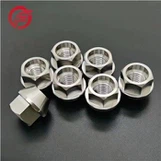
In addition to moly foil, we also offer a variety of other molybdenum products. Check out our Cold - Rolled 360 361 363 Molybdenum Sheet, which is available in different sizes and is suitable for a wide range of industrial applications. We also have 360 361 363 High Purity 99.95% Molybdenum Nuts for high - performance fastening needs. And for those in need of screws made of molybdenum, our Molybdenum Screw is the perfect choice.
Contact for Purchase and Negotiation
If you are interested in our moly foil products or have specific requests regarding dimensions, feel free to reach out to us. We are always ready to provide you with detailed information, samples, and competitive quotes. Our team of experts can assist you in selecting the right dimensions of moly foil for your application, whether it's a standard or custom - made product. Let's start a conversation and see how we can meet your moly foil needs.
References
- "Molybdenum: Properties, Applications, and Technology" edited by J. F. Elliott and M. A. Omar.
- Journal of Materials Science and Engineering articles on molybdenum materials.
- Industry reports on the molybdenum market and its applications.