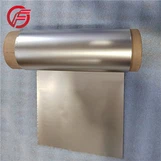

Hey there! As a supplier of Ni foil, I often get asked about how our Ni foil performs in a vacuum environment. So, I thought I'd take a deep - dive into this topic and share all the deets with you.
First off, let's talk about why the performance of Ni foil in a vacuum is a big deal. A vacuum environment is quite different from our normal atmospheric conditions. In a vacuum, there's a lack of air molecules, which means reduced oxidation and fewer contaminants. This makes it an ideal setting for many high - tech applications, like in aerospace, semiconductor manufacturing, and scientific research.
Physical Properties in a Vacuum
One of the key things about Ni foil in a vacuum is its thermal stability. Nickel has a relatively high melting point, around 1455 °C (2651 °F). This means that in a vacuum, where there's no air to cause oxidation or heat loss through convection, the Ni foil can withstand high temperatures without quickly deforming. For example, in some semiconductor manufacturing processes that take place in a vacuum, the Ni foil can be used as a substrate for thin - film deposition. The high thermal stability allows it to maintain its shape and structure while the deposition process happens at elevated temperatures.
Another important physical property is its electrical conductivity. Nickel is a good conductor of electricity. In a vacuum, there are no air molecules to interfere with the flow of electrons. This makes the Ni foil an excellent choice for electrical applications in vacuum environments. For instance, in some space - based electronics, Ni foil can be used as a conductor or a component in electrical circuits. Its stable electrical properties ensure the reliable operation of the electronic devices in the harsh vacuum of space.
Chemical Behavior in a Vacuum
Oxidation is a major concern in normal atmospheric environments, but in a vacuum, this problem is significantly reduced. Since there's a lack of oxygen, the Ni foil doesn't react with oxygen to form oxides as easily as it would in air. This is great news for applications where corrosion resistance is crucial. For example, in vacuum chambers used for material testing, Ni foil can be used as a sample holder or a contact material. Its low oxidation rate in a vacuum ensures that the test results are not affected by the corrosion of the foil itself.
However, it's not completely free from chemical reactions. Some contaminants might still be present in the vacuum chamber, and in some cases, the Ni foil can react with trace amounts of these contaminants at high temperatures. But compared to its behavior in air, the chemical reactivity of Ni foil in a vacuum is much more predictable and controllable.
Mechanical Performance in a Vacuum
When it comes to mechanical performance, Ni foil retains its flexibility and ductility in a vacuum. It can be easily formed into different shapes without breaking, which is useful in various manufacturing processes. For example, in the production of vacuum - sealed components, the Ni foil can be bent and shaped to fit the specific design requirements.
In addition, the low outgassing property of Ni foil in a vacuum is also a plus. Outgassing refers to the release of gases from a material when it's placed in a vacuum. High outgassing can contaminate the vacuum environment and affect the performance of other components. Our Ni foil has relatively low outgassing rates, making it suitable for high - vacuum applications where a clean environment is essential.
Comparison with Other Materials
Now, let's compare Ni foil with some other materials commonly used in vacuum environments. Titanium is another popular choice, and you can check out ASME SB - 265 UNS R54520 Gr6 Titanium Plate, DIN 7976 Gr5 Titanium Self - tapping Screws, and Grade 2 Titanium Straight Tee Pipe Tee Fittings if you're interested in titanium products.
Titanium has excellent corrosion resistance and a high strength - to - weight ratio. However, nickel is generally more cost - effective and has better electrical conductivity. In applications where electrical conductivity is a top priority, like in some electrical heating elements in a vacuum, Ni foil would be a better choice.
On the other hand, in applications where extreme corrosion resistance and high strength are needed, such as in some aerospace vacuum systems, titanium might be more suitable. But for a wide range of general - purpose vacuum applications, Ni foil offers a good balance between performance and cost.
Applications in Different Industries
Aerospace
In the aerospace industry, Ni foil is used in various vacuum - related applications. For example, in satellite components, it can be used as a heat - shielding material or a part of electrical circuits. The high thermal stability and electrical conductivity of Ni foil make it reliable in the harsh vacuum environment of space.
Semiconductor Manufacturing
Semiconductor manufacturing often takes place in a vacuum to prevent contamination. Ni foil can be used as a seed layer or a mask material in the deposition and etching processes. Its chemical stability and mechanical properties allow it to withstand the high - energy processes involved in semiconductor production.
Scientific Research
In scientific research, especially in experiments conducted in vacuum chambers, Ni foil can be used as a sample carrier or a part of experimental set - ups. Its predictable behavior in a vacuum helps researchers obtain accurate and reproducible results.


Contact for Procurement
If you're interested in learning more about our Ni foil or are thinking of making a purchase, don't hesitate to reach out. We're always ready to provide you with detailed product information, samples, and competitive pricing. Whether you need Ni foil for a small - scale research project or a large - scale industrial application, we're here to meet your needs. Just drop us a line, and we can start discussing your requirements and how our Ni foil can fit into your projects.
References
- "Properties of Nickel and Nickel Alloys" by ASM International
- "Vacuum Technology Handbook" by O'Hanlon, J. F.