
Can a Titanium Rod Be Used in High-Temperature Environments?

If you've ever stopped to think about the materials that make aerospace components, industrial heat exchangers, or power generation parts work, there's a good chance titanium crossed your mind. As a titanium rod supplier, I get asked this question all the time: can a titanium rod really hold up in high-temperature settings? It's not a simple yes or no-because not all titanium is created equal, and "high temperature" means different things to different industries. Let's break this down, with real-world examples from our products, so you can see exactly when titanium is a great fit, and when you might need to pick the right alloy to avoid issues.
First, let's get one thing straight: pure titanium and many common titanium alloys are surprisingly stable at moderate temperatures, but they start to behave differently once you push past their threshold. At temperatures below 400°C (752°F), most standard titanium rods resist corrosion, maintain their strength, and stay lightweight-way better than steel or even some stainless steels in corrosive, heat-exposed settings. But when temperatures climb above that, two big challenges kick in: oxidation and a loss of structural integrity.
That's where alloy selection becomes non-negotiable. Most people reach for grade 5 Ti6Al4V as their go-to titanium rod, and for good reason-it's strong, versatile, and works great up to about 400°C. But push it past 400°C, and things start to change. The aluminum and vanadium in Ti6Al4V help boost strength, but at higher temps, they start to react with oxygen and nitrogen from the air, forming brittle surface layers that can crack or flake off. That's a problem if you're working with components that need to hold tight under pressure at, say, a chemical plant's reactor or a gas turbine's exhaust system.
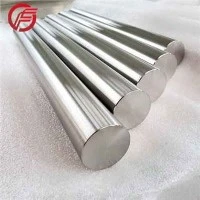
So what do you use when you need titanium at higher temperatures? Let's talk about some of the alloys we supply that are built for that. One of our top picks for intermediate high-temperature use is the GOST (ГОСТ)26492 TC11 alloy BT9 Titanium Round Bar. This Russian-standard alloy is specifically engineered for thermal stability-its balanced mix of aluminum, molybdenum, and vanadium lets it maintain high tensile strength up to 500°C (932°F). I've seen BT9 rods used in aircraft landing gear parts and engine components that cycle between low and high heat repeatedly; they don't oxidize as much as Ti6Al4V, and they don't soften as pure titanium would. For anyone working in aerospace or industrial machinery where temps hit 400–500°C, this is a solid choice.
Wait, but what if you need even higher performance? There's a group of titanium alloys called "near-alpha" alloys that are designed specifically for continuous use at 500–600°C, and even up to 650°C for short periods. These have a higher percentage of alpha-phase titanium, which is more stable at high temps than the beta phase in alloys like Ti6Al4V. If your application is operating at the upper end of that range, avoiding alloys that have too much beta phase is key-those phases can cause creep (slow, permanent deformation under constant stress at high heat), which is a death sentence for components that need to stay precise over time.
Now, let's address a common myth: some people think pure titanium (grade 1 or grade 2) is only for room temperature use. That's mostly true, but wait-grade 1 is actually usable up to about 300°C, and it's super resistant to corrosion, which makes it a good fit for heat exchangers in chemical processing where both heat and corrosive fluids are present. Our High Purity ASTM B348 Gr1 Titanium Bar is often used in those applications because its low impurity content (less than 0.1% total interstitial elements like oxygen, nitrogen, and carbon) keeps it ductile and resistant to oxidation even at moderately high temps. It won't have the strength of grade 5, but if you need something that won't break down when exposed to hot acidic or caustic environments, pure grade 1 titanium is hard to beat.

What about medical applications? You might not associate medical implants with high temperatures, but some specialized implant tools or even components for medical equipment can see elevated heat during manufacturing or use. For example, surgical drills or implant fixtures might get warm during use, and they need to stay non-reactive and strong. Our ASTM F136 Gr5ELI Gr23 Medical Titanium Rods are a modified version of Ti6Al4V, with lower interstitial elements and a finer microstructure. While their maximum continuous use temp is still around 400°C, their biocompatibility and thermal stability make them ideal for any medical setting where mild heat is a factor. If you're working on medical devices that need titanium rods, this is the alloy to pick.
There's another alloy I want to mention that's perfect for slightly lower temps but has a unique benefit: our Ti0.3Mo0.8Ni UNS R53400 Gr12 Titanium Bar. Grade 12 is a low-alloy titanium with small amounts of molybdenum and nickel, and it works great up to 400°C-same as grade 5, but it's way more resistant to crevice corrosion in hot saltwater. That makes it a go-to for marine heat exchangers or parts that are exposed to hot, salty fluids, where other alloys would corrode quickly. Even though it's not designed for extremely high heat, its combination of strength, corrosion resistance, and thermal stability at moderate temps makes it a workhorse for many industrial applications.
Now, let's talk about the risks of picking the wrong titanium rod for high-temperature use. I've seen this firsthand: a few years back, a customer came to us with a batch of failed parts from a chemical plant's distillation column. They'd used standard grade 5 Ti6Al4V rods for support brackets that were exposed to temps of 450°C. Within six months, the rods had developed thick, brittle oxide layers, and some had even snapped under load. The problem? Grade 5 just isn't stable above 400°C-at that temp, its vanadium content starts to accelerate oxidation, and the material loses about 30% of its tensile strength. We swapped them out for GOST BT9 rods, and those parts are still going strong five years later.
So what's the rule of thumb for choosing titanium for high-temperature environments? First, define your operating temperature: if it's under 300°C, you can use pure grades like Gr1 or Gr2 for corrosion-focused applications, or Gr5 for strength. If it's between 300–500°C, go for near-alpha alloys like BT9 (our GOST (ГОСТ)26492 TC11 alloy) or other titanium alloys designed for thermal stability. If you're going above 500°C, you'll need even more specialized near-alpha or alpha-beta alloys with higher alloying content, but those are less common for most general industrial use.
Another factor to consider is cycling temperatures that go up and down repeatedly. Titanium has a low coefficient of thermal expansion, which is a big plus, but when you cycle between hot and cold, you get thermal stress. Some alloys handle this better than others. BT9, for example, has a more balanced thermal expansion than pure titanium, so it doesn't develop as much stress from repeated heating and cooling. That's why it's so popular for aerospace components that go from ground level (room temp) to high altitude (sub-zero and then engine heat) and back.
I should also mention that when titanium is exposed to temperatures above 550°C in air, it starts to absorb oxygen and nitrogen, which makes it brittle. This is called "alpha case" formation, and it can compromise the material's toughness. If you need to work at those temps, you have to either use an alloy that's resistant to this (some advanced aerospace alloys can go up to 650°C with minimal alpha case) or work in an inert atmosphere. For most industrial applications, though, staying below 500°C avoids this issue entirely.
As a titanium rod supplier, my number one priority is helping customers pick the right material, not just selling them the cheapest option. I've had customers come to us assuming all titanium is the same, and they end up with parts that fail prematurely because they used the wrong alloy for their temp range. That's why we're always happy to walk through your application: what's the temperature, what fluids or environments will the rod be exposed to, does it need to have a certain strength or weight? Once we know that, we can point you to the right alloy-whether that's our High Purity ASTM B348 Gr1 Titanium Bar for moderate heat and corrosion, the GOST BT9 for intermediate high temps, or any of our other titanium rods.
If you're working on a project where titanium rods will be exposed to high temperatures-whether it's aerospace, power generation, chemical processing, marine engineering, or even medical device manufacturing-don't guess on the alloy. Reach out to us to discuss your specific needs. We have years of experience helping customers navigate material selection for thermal environments, and we can provide detailed specs, test data, and custom orders to fit your project.
When it comes to using titanium rods in high-temperature environments, the answer is a resounding yes-as long as you pick the right alloy. Not all titanium is built for heat, but with the right choice, titanium's unique combination of strength, light weight, and corrosion resistance makes it one of the best materials for the job.
References
- Titanium Alloys: An Overview for High-Temperature Applications. Titanium Industry Association, 2022.
- ASTM Standards for Titanium and Titanium Alloys (B348, F136). American Society for Testing and Materials, 2023.
- GOST 26492: Titanium Alloys for Industrial and Aerospace Applications. Interstate Council for Standardization, Metrology, and Certification, 2019.
- Creep Behavior of Titanium Alloys at Elevated Temperatures. Journal of Materials Engineering and Performance, vol. 31, no. 4, 2022, pp. 2897–2908.
- Corrosion Resistance of Titanium Grades in Hot Saline Environments. Corrosion Science, vol. 187, 2021, 109452.