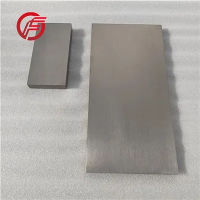

Hey there! As a TZM plate supplier, I often get asked about the difference between TZM plates and tantalum plates. It's a great question, and in this blog post, I'm gonna break it down for you.
Let's start with the basics. TZM, which stands for Titanium-Zirconium-Molybdenum, is an alloy. The alloy consists mainly of molybdenum, with small amounts of titanium and zirconium added. These additional elements enhance its properties, making it a high - performance material. On the other hand, tantalum is a chemical element with the symbol Ta and atomic number 73. It's a rare, hard, blue - gray, lustrous transition metal.
Physical Properties
Density
One of the most obvious differences between TZM plates and tantalum plates is their density. Tantalum has a very high density of about 16.69 g/cm³. This high density makes it useful in applications where weight is not a major concern, but mass is needed for specific functions, like in some types of ballast or radiation shielding. In contrast, TZM plates have a lower density. The density of TZM is around 10.2 g/cm³, which is significantly less than that of tantalum. This lower density can be an advantage in applications where weight reduction is important, such as in aerospace components.
Melting Point
Both TZM and tantalum are known for their high melting points, but there's a difference. Tantalum has an extremely high melting point of about 3017°C. This makes it suitable for use in high - temperature environments, like in the production of heating elements in furnaces. TZM also has a high melting point, around 2617°C. While it's lower than that of tantalum, it's still high enough for many high - temperature applications. TZM's slightly lower melting point can be beneficial in some cases as it may require less energy to process.
Mechanical Properties
Strength
TZM plates are known for their excellent strength, especially at high temperatures. The addition of titanium and zirconium in the TZM alloy increases its strength compared to pure molybdenum. This high - temperature strength makes TZM plates ideal for use in applications such as aerospace engines, where components need to withstand high stress and temperature. Tantalum, on the other hand, has good ductility and moderate strength. It can be easily formed into various shapes, but its strength at high temperatures is not as high as that of TZM.
Ductility
Tantalum is highly ductile, which means it can be easily drawn into wires or hammered into thin sheets without breaking. This property makes it suitable for applications where complex shapes need to be formed, such as in the production of capacitors. TZM, while it has some ductility, is not as ductile as tantalum. However, its strength often compensates for its relatively lower ductility in many applications.


Chemical Properties
Corrosion Resistance
Tantalum is well - known for its excellent corrosion resistance. It can resist corrosion from a wide range of chemicals, including acids and alkalis. This makes it a popular choice in the chemical industry for equipment such as reaction vessels and heat exchangers. TZM also has good corrosion resistance, but it's not as resistant as tantalum in some harsh chemical environments. However, in less aggressive conditions, TZM can still provide sufficient corrosion protection.
Applications
TZM Plate Applications
TZM plates are widely used in the aerospace industry. They are used in the manufacturing of rocket nozzles, turbine blades, and other high - temperature components. The high - temperature strength and relatively low density of TZM make it an ideal material for these applications. In addition, TZM plates are also used in the electronics industry. For example, they can be used as electrodes in high - power vacuum tubes. If you're interested in other molybdenum - based products, you can check out our Molybdenum Screw and High temperature resistance R03600 Molybdenum Fastener.
Tantalum Plate Applications
Tantalum plates are commonly used in the chemical industry due to their excellent corrosion resistance. They are used in the construction of reaction vessels, heat exchangers, and other equipment that comes into contact with corrosive chemicals. Tantalum is also widely used in the electronics industry, especially in the production of capacitors. The high dielectric constant of tantalum makes it an ideal material for high - performance capacitors. If you're looking for a high - temperature molybdenum - based foil, our Molybdenum High Temperature Alloy Tzm Foil might be of interest to you.
Cost
Cost is another factor to consider when choosing between TZM plates and tantalum plates. Tantalum is a rare metal, and its extraction and processing are relatively expensive. This makes tantalum plates more costly compared to TZM plates. TZM, being an alloy mainly based on molybdenum, is generally more affordable. However, the cost can also vary depending on the specific requirements of the application, such as the size, thickness, and quality of the plates.
Conclusion
In conclusion, both TZM plates and tantalum plates have their own unique properties and applications. TZM plates are great for high - temperature, high-strength applications, especially in the aerospace and electronics industries. They offer a good balance of strength, density, and cost. Tantalum plates, on the other hand, are known for their excellent corrosion resistance and high ductility, making them suitable for the chemical and electronics industries.
If you're in the market for TZM plates or have any questions about the differences between TZM and tantalum plates, feel free to reach out. We're here to help you make the right choice for your specific application. Whether you need a small quantity for a prototype or a large order for mass production, we can provide you with high - quality TZM plates. Let's start a conversation about your procurement needs and see how we can work together!
References
- "Materials Science and Engineering: An Introduction" by William D. Callister Jr. and David G. Rethwisch
- "Handbook of Advanced Electronic and Photonic Materials and Devices," edited by H.S. Nalwa