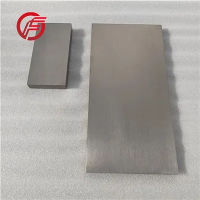

Hey there! I'm a supplier of moly foil, and today I wanna chat about how moly foil interacts with radiation. It's a pretty cool topic, and understanding this can help us see the many uses of moly foil in different industries.


First off, let's talk about what moly foil is. Molybdenum is a super useful metal. It's got a high melting point, is strong, and has good thermal and electrical conductivity. Moly foil is just a thin sheet of this awesome metal.
Now, when it comes to radiation, there are different types - like alpha, beta, and gamma radiation. Each type interacts with moly foil in its own way.
Alpha radiation consists of alpha particles, which are basically helium nuclei. These particles are relatively large and heavy. When alpha particles hit moly foil, they can't penetrate very far. The foil acts as a barrier, and the alpha particles get stopped pretty quickly. This is because the positively charged alpha particles interact with the electrons in the moly foil. The electrons in the foil can slow down and eventually stop the alpha particles.
Beta radiation is made up of beta particles, which are either electrons or positrons. These particles are much smaller and lighter than alpha particles. Beta particles can penetrate moly foil more easily than alpha particles. However, the foil still affects them. As the beta particles pass through the foil, they interact with the atoms in the foil. This interaction can cause the beta particles to lose energy and change direction. Some beta particles might even get absorbed by the foil.
Gamma radiation is a form of electromagnetic radiation, like X - rays but with higher energy. Gamma rays are very penetrating. Moly foil can't completely stop gamma rays, but it can reduce their intensity. When gamma rays pass through moly foil, they interact with the atoms in the foil through a process called Compton scattering. In Compton scattering, the gamma ray gives some of its energy to an electron in the foil, and then the gamma ray continues on its way with less energy. Another way gamma rays interact with the foil is through the photoelectric effect, where the gamma ray is completely absorbed by an atom in the foil, and an electron is ejected.
So, why is this interaction between moly foil and radiation so important? Well, in the nuclear industry, moly foil can be used as a shielding material. For example, in nuclear power plants, it can help protect workers and equipment from harmful radiation. It can also be used in radiation detection devices. The way moly foil interacts with radiation can be measured and used to detect the presence and intensity of different types of radiation.
Now, if you're in the market for moly foil or other molybdenum products, we've got a great selection. We also offer 360, 361, 363 Moly Rod Pure Molybdenum Rod. These rods are made of high - quality molybdenum and are perfect for various applications. If you need fasteners, we have Molybdenum Screw and 360, 361, 363 Molybdenum Bolts available.
Whether you're working on a research project, in the nuclear industry, or any other field that requires molybdenum products, we're here to help. If you're interested in our products or have any questions, don't hesitate to reach out. We're always happy to have a chat and see how we can meet your needs.
References:
- Introduction to Nuclear Engineering, Lamarsh, John R.
- Radiation Detection and Measurement, Knoll, Glenn F.