
Vacuum environments, from scientific laboratories to industrial manufacturing and aerospace applications, demand materials and components that can function reliably under extreme conditions. As a tungsten screw supplier, we often receive inquiries about whether tungsten screws are suitable for use in these specialized settings. Let's delve into this topic to understand the viability of tungsten screws in vacuum environments.
Properties of Tungsten
To assess the usability of tungsten screws in vacuum environments, it's essential to first understand the inherent properties of tungsten. Tungsten is a refractory metal known for its remarkable characteristics. It has the highest melting point of all metals, at approximately 3,422 °C (6,192 °F). This high melting point provides excellent thermal stability, making tungsten capable of withstanding extremely high temperatures without significant deformation or loss of strength.
Moreover, tungsten has a relatively low coefficient of thermal expansion. This means that its dimensional changes are minimal when subjected to temperature variations. In vacuum environments where temperature fluctuations can be substantial, this property helps maintain the integrity of the structure and the performance of the screws.
Another important aspect is tungsten's high density. With a density of about 19.3 g/cm³, tungsten is one of the densest metals. This makes it a suitable choice for applications where high mass in a small volume is required, such as in balancing and counterweight systems in vacuum machinery.
Tungsten also exhibits good corrosion resistance. It can resist oxidation and chemical attacks in many environments, which is crucial as vacuum systems may be exposed to residual gases or contaminants that could potentially cause corrosion to conventional materials.
Vacuum - Environment Requirements
Vacuum environments come with unique requirements. One of the primary concerns is outgassing. Outgassing refers to the release of gases from the surface or interior of a material when it is placed in a vacuum. These gases can contaminate the vacuum system, affect the performance of sensitive equipment, or interfere with experimental results. Materials used in vacuum environments must have low outgassing rates to maintain the desired vacuum level.
Another key requirement is mechanical stability. In vacuum applications, components may be subjected to various mechanical stresses, including vibrations, shocks, and tensile or compressive forces. The materials need to be able to withstand these forces without failure or significant deformation.
Additionally, thermal management is critical. Temperature differences can occur due to radiation, conduction, or the operation of equipment within the vacuum chamber. The materials must be able to handle these temperature variations without compromising their mechanical and physical properties.
Tungsten Screws in Vacuum Environments
Low Outgassing
Tungsten is generally considered to have a low outgassing rate. This is because of its high melting point and stable atomic structure. During the manufacturing process of tungsten screws, proper heat - treatment and cleaning procedures can further reduce the amount of adsorbed gases on the surface. As a result, tungsten screws can be a reliable choice for vacuum applications where maintaining a high - quality vacuum is essential. For instance, in electron microscopy, which requires a high - vacuum environment to function accurately, tungsten screws can be used to assemble the components without introducing significant gas contaminants.
Mechanical Stability
The high strength and hardness of tungsten make it well - suited to handle mechanical stresses in vacuum environments. Tungsten screws can provide a secure fastening solution even under conditions of vibration and shock. In aerospace applications, where components are often exposed to extreme mechanical forces during launch and flight, the use of tungsten screws can ensure the structural integrity of the equipment in the vacuum of space.
Thermal Performance
The low coefficient of thermal expansion and high melting point of tungsten contribute to its excellent thermal performance in vacuum environments. Whether it is in a high - temperature vacuum furnace or a cryogenic vacuum system, tungsten screws can maintain their dimensional stability and mechanical strength. This is particularly important in semiconductor manufacturing processes, where precise component alignment is required under different temperature conditions within the vacuum chamber.
Applications of Tungsten Screws in Vacuum Environments
Scientific Research
In scientific research, such as in particle accelerators and vacuum spectroscopy chambers, the use of tungsten screws is crucial. These experiments often require a clean and stable vacuum environment, and tungsten screws can meet the requirements in terms of low outgassing, mechanical stability, and thermal resistance. They are used to assemble and secure various components, ensuring the proper functioning of the experimental set - up.

Aerospace
The aerospace industry frequently uses vacuum environments for testing and space applications. Tungsten screws are used in satellite components, rocket engines, and space telescopes. In these applications, the screws need to withstand extreme temperature variations, high mechanical stresses, and the harsh conditions of the space vacuum. Tungsten's properties make it an ideal material for these critical components.
Semiconductor Manufacturing
Semiconductor manufacturing processes often take place in vacuum chambers. Tungsten screws are used to fasten parts of the manufacturing equipment, such as wafer holders and masking systems. Their ability to maintain dimensional accuracy and mechanical integrity under different temperature and pressure conditions is essential for ensuring the high - quality production of semiconductors.
Product Sourcing
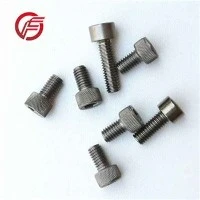
If you are looking for high - quality tungsten screws for your vacuum environment applications, we are here to assist you. Our company offers a wide range of tungsten fasteners, including Tungsten Set Screws Tungsten Bolts And Nuts. Our products are manufactured using advanced techniques and strict quality control measures to meet the specific requirements of vacuum applications.
We understand that each customer's needs may vary, and our team of experts is ready to work with you to provide customized solutions. Whether you need a specific size, thread type, or surface finish for your tungsten screws, we can accommodate your requests.
If you are interested in purchasing our tungsten screws or have any questions regarding their suitability for your vacuum environment, please feel free to contact us for a detailed discussion. We are committed to providing you with the best products and services to ensure the success of your projects.
References
- Kutz, M. (Ed.). (2019). Mechanical Engineers' Handbook: Materials and Mechanical Design. John Wiley & Sons.
- ASM Handbook Committee. (2004). ASM Handbook: Volume 2, Properties and Selection: Nonferrous Alloys and Special - Purpose Materials. ASM International.